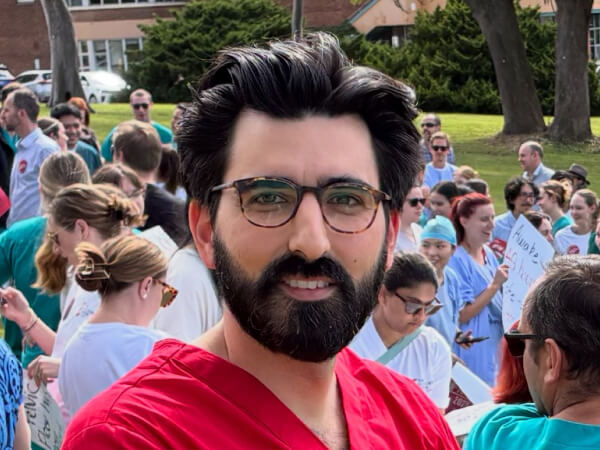
Dr Alexander Whitfield
ASMOF NSW is bringing the unvarnished truth from the hospitals to the public and to the halls of Parliament.
We spoke to Dr Alexander Whitfield, an Emergency Physician with 15 years of experience across the state. He describes an alarming shift to a “resource-poor” environment, where doctors are forced to make decisions that compromise the very standards they were trained to uphold.
Member Case Study: Why NSW Public Health is Falling Behind Global Standards
Q: What are the challenges you’re facing day-to-day?
"When I was a junior doctor at John Hunter, a massive referral hospital, we would still see every single patient in the ED on a night shift. That’s unheard of now. Patients are waiting 12+ hours overnight. There’s been about a 10% increase in patient load, but staffing, beds, and services haven’t increased. It’s absolutely overwhelming."
Q: How is that impacting the patients?
"There are lots of bad outcomes happening. There was a man who waited 12 hours overnight with a hernia that had bowel stuck in it. Unfortunately, he needed a bowel resection, which could have been avoided if he’d been seen earlier. I’ve had a woman just start crying after waiting eight hours to see me. It's torturous. You’re constantly considering who’s going to die to make room for someone else.”
It’s insane, the level of resource scarcity. My wife is an infectious diseases physician, and one of her colleagues has done a lot of work with MSF (Doctors Without Borders). As part of a global medication monitoring project, they said, ‘We’re in a resource-poor setting; this isn’t applicable.’ NSW is now effectively operating in that same space in many respects. We simply can’t practise to global standards in a lot of cases - it isn’t an option. It’s a crazy thing to be saying in Australia in the 21st century"
Q: Do you believe funding and resourcing are missing at a top level?
"Absolutely. Part of the problem is activity-based funding models. We employ almost no administrative staff and rely on clinical staff to document activity to inform funding. As a result, we lose funding because we can’t properly record the work we’re doing. But it’s not the role of doctors to hire administrators."
Q: What would you want to say to the public?
“We’re both having to suffer through this. If you want to advocate, writing to hospitals isn’t very effective. You need to be contacting the Health Minister and the Premier directly. The core issue is resource scarcity - and it will only change if the public starts putting pressure on elected representatives"
Q: What would you want to say to an MP?
“Healthcare in the 21st century costs money. There’s no way around it. You need to pay for staff, equipment, and infrastructure. It’s a binary choice: either you fund it, or the consequences are severe. We’re seeing those consequences right now. You cannot run a 21st-century healthcare system on 1990s funding. And the public is paying the price.”
Q: What would you say to another doctor who's on the fence about joining or getting involved with ASMOF?
“Nothing will change unless we make it change. I’ve had disputes resolved by the union, and many others have too. The more members we have, and the more active we are, the greater the pressure for change. You can already see it - in the past 18 months, we’ve won more because our membership has grown significantly. The system won’t improve unless we’re all involved. No one listens unless we stand together.”
Join the fight for a safer system. Our public health system should not be a "resource-poor setting." At ASMOF NSW, we are fighting for the staffing, resources, and respect that doctors and patients deserve.
Your voice is your power. Join us to ensure that when we speak, the government has no choice but to listen.
Join asmof nsw today!
Are you a salaried doctor working in NSW? Only by being a member can you add your voice and join the fight for better and safe working conditions!
Related TESTIMONIALS
See other case studies.